
The sandwich generation means adults caring for an aging parent while also raising or financially supporting their own children. Pew Research found 23% of US adults are in this position, rising to 54% of people in their forties. The term describes the squeeze, but not the part that usually comes first: noticing something is wrong before anyone else agrees with you.
Books in this article

If you have landed here, it is probably because somebody used the phrase and it snagged on something. You are handling a parent and a child in the same week, possibly in the same afternoon, and somebody called you the sandwich generation like it was a cute observation rather than a description of your life.
So here is what it actually means, where it came from, and the part of it nobody puts in the definition.
The short answer
The sandwich generation means adults who are caring for an aging parent while also raising children or supporting them financially.
Pew Research Center puts a number on it. Based on a survey conducted in October 2021, about 23% of US adults have a parent aged 65 or older and are either raising a child under 18 or helping an adult child financially.
That average hides how concentrated it is:
- 54% of people in their forties
- 36% of people in their fifties
- 27% of people in their thirties
- 6% of people under 30, and 7% of people 60 and over
More than half of everyone in their forties. If you are in that decade and you feel like everyone you know is dealing with this, it is because they are.
Where the phrase came from
A professor of social work named Dorothy Miller coined it in 1981. She was not making a joke about lunch. She was writing about the unequal exchange of resources between generations — how support flows in both directions out of one household in the middle — and she noted that the people in that position were under a great deal of stress.
The word stuck. Merriam-Webster added it to the dictionary in 2006.
I have some affection for the term because it does one thing well: it makes the squeeze visible. Before there was a name for it, you were just a person who was tired for no reason anyone could point at.
What the definition leaves out
Here is my problem with it, and it is not a small one.
The definition describes a state you are already in. Parent on one side, child on the other, you in the middle. It assumes everybody agrees the parent needs care.
That is not where it starts.
It starts months or years earlier, when you notice something and nobody else does. A late notice on a counter in a house where bills were never late. Three of the same shampoo in a cabinet, bought on three separate trips. A pill organizer still full on a Thursday. You mention it, and somebody tells you that you are overthinking, that she is fine, that she is just getting forgetful.
There is no name for that phase. There is no Pew statistic for it. But it is the hardest part, because you are carrying the knowledge alone and being told the knowledge is wrong.
By the time you qualify as the sandwich generation, the argument is usually over. The lonely part came first.
What being “in the middle” actually costs
The research talks about time and money, and both are real. But the things that wear people down tend to be smaller and harder to put in a survey.
You become the person who knows things. Which medication, which doctor, which account, which anniversary is going to be difficult. Nobody assigns you this. You just end up as the household’s memory, and it cannot be shared out easily because explaining it takes longer than doing it.
Your own health goes last. It is the standard pattern and knowing about it does not seem to prevent it. If you take one practical thing from this page, make it this: tell your own doctor that you are a caregiver. Get it in your chart. It changes what they ask you.
You lose the small talk. Friends ask how your mother is. They stop asking how you are, because you are not the one who is sick. That is how the isolation arrives — not through anyone being unkind, but through a slow narrowing of what people think to ask.
What to do first
Not a plan. Three things that cost nothing and that I wish somebody had told me at the start.
Write it down, with dates. One line per observation, no adjectives, no conclusions. June 3 — two past-due notices. Never happened before. Do not write what you think it means. The notebook is for the doctor eventually, but its first job is to keep you from being talked out of your own eyes.
Read the house, not the person. She will tell you she is fine, and she will be convincing, because performing fine for an hour is a skill that survives a long time. The house does not perform. Look at the mail, the pantry, the fridge, the medicine cabinet, the car.
Find one person who believes you. It does not have to be family. It is often better if it is not.
A note on the other half of the sandwich
Something nobody warns you about: the hardest part of a visit is often that you run out of things to say.
You can only ask about the doctor so many times. Sitting in silence feels like failing. So people start filling the hour with logistics, and the visit turns into an admin meeting between two people who love each other.
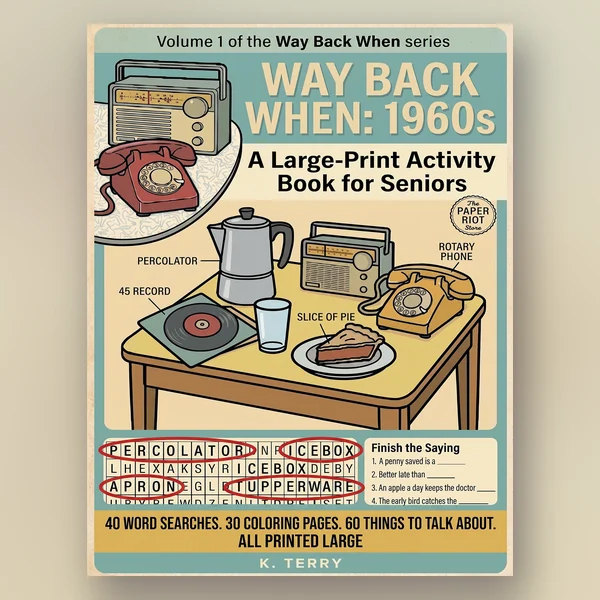
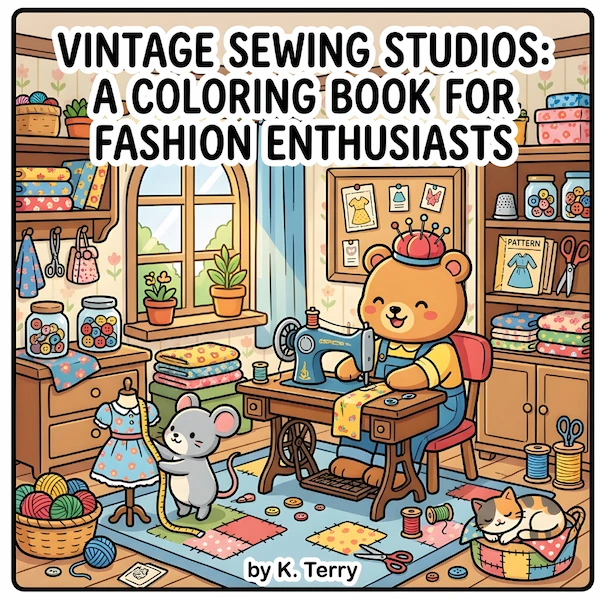
It helps enormously to have something on the table that is pointed at, rather than at each other. Way Back When: 1960s exists for that reason — word searches and conversation starters in large type, built for sitting side by side rather than across. A large-print word search does the same job more simply. So does a coloring book with a subject worth talking about, if her hands still like doing things.
None of that is treatment and I would not insult you by dressing it up as any. It is a way to spend an hour together that neither of you has to perform through.
You are probably earlier than you think
The thing about the sandwich generation framing is that it arrives with the situation already established. Most people find the phrase well after they are living it.
If you are reading this because you have started to wonder — not because anyone has confirmed anything, just because something is nagging at you — then you are early. That is not a bad place to be. It is the only place where the easy things still work: the conversations, the paperwork, the accounts, all of it far simpler now than it will be in eighteen months.
Being early feels like being wrong. It usually is not.
Questions people ask
What exactly counts as being in the sandwich generation?
How many people are in the sandwich generation?
Who came up with the term?
What should I do first if I think I am heading into this?
Is there a word for caring for a parent without having children?
The Three A.M. Pages
Everything practical from You're Not Overreacting, collected in one free PDF — what to check in the house, the exact words to use on the phone to her bank, what to ask when someone gives you a timeline.
Get the free pages